Mark sat down at thanksgiving with his laptop open and pulled up this massive Google Sheet. Rows and rows. Every copay, every prescription, every ER bill going back to 2007. He added it all up: $412,000 spent on type 1 diabetes in 29 years. Just sitting there between the stuffing and the green bean casserole like thats a normal thing to show people.
He was diagnosed at nine. Thirty-eight now.
I actually checked his math later because the number seemed high. It wasnt. The American Diabetes Association puts average annual T1D costs at $18k-35k with insurance. Marks at about $25k. Times 29 years. Plus three ER visits that ran $8k each out of pocket before his deductible reset. Plus the insulin he bought out of pocket in 2020 when he was between jobs. Plus the Dexcom sensors insurance wouldnt cover for the first two years he had them because they werent considered "medically necessary" yet, which, ok.
$412k checks out. Probably conservative even.
Then in June 2025 Vertex published their zimislecel results. Twelve patients with type 1 diabetes. Ten of them completely off insulin. Not reduced — eliminated. A guy who had been injecting 34 units per day for over 20 years: zero. His C-peptide levels, which measure whether your body is actually producing insulin, went from undetectable to normal range.
You can see why Mark called me the next day asking questions about stem cell therapy for diabetes.
What the New Therapy Costs
Zimislecel (used to be called VX-880) isnt commercially available yet. Vertex plans to file with the FDA in 2026. So theres no published price. But we can estimate based on the manufacturing complexity, comparable cell therapies already on the market, and what Ive heard from people connected to the clinical program.
Casgevy, the CRISPR sickle cell therapy, launched at $2.2 million. Kymriah for leukemia is $475k. Cell therapies are expensive because making them is expensive. For zimislecel specifically, estimates range from $150,000 to $400,000 for the complete treatment including screening, manufacturing, the procedure, and monitoring.
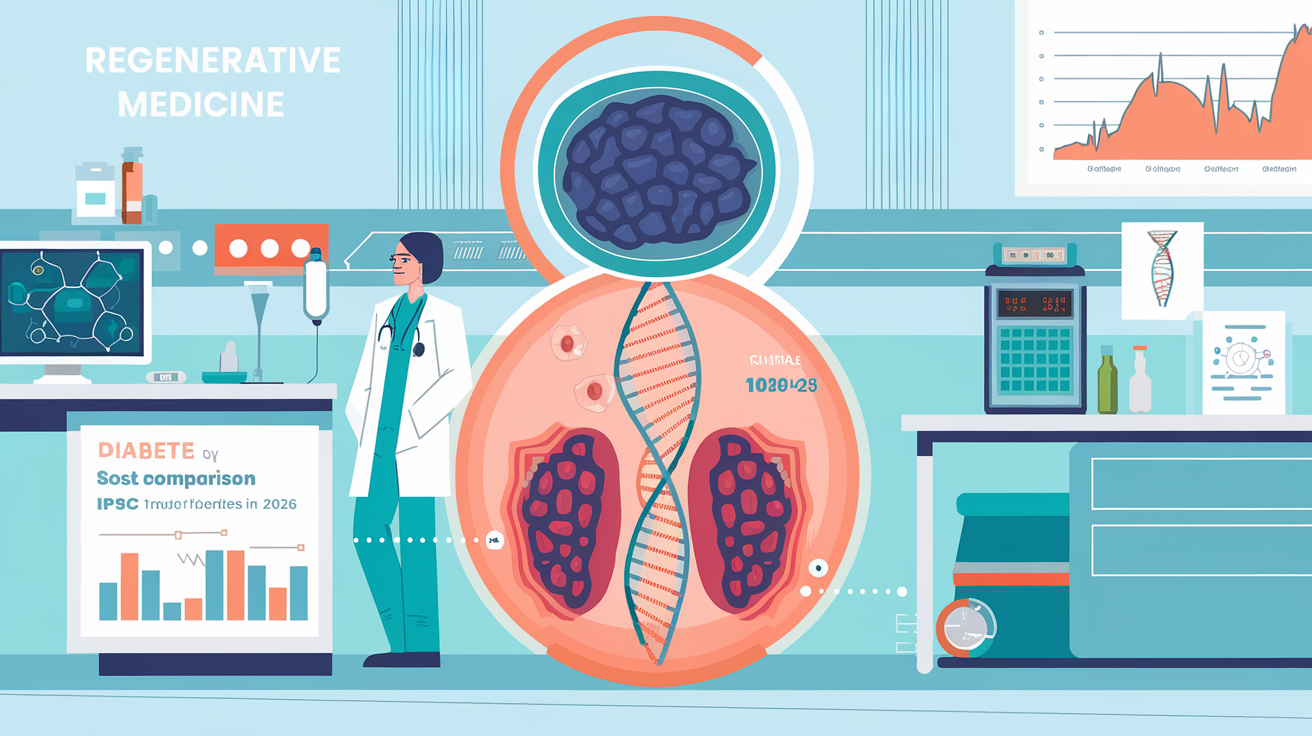
Visual overview: Key facts about stem cell therapy for diabetes cost comparison iPSC vs traditional treatments 2026
Breaking it down:
Screening takes about six weeks. Immune panels, autoantibody testing, cardiac workup, C-peptide measurement. $15k to $25k.
Cell manufacturing is the big ticket item. They grow functional islet cells in a GMP-certified clean room. Every batch is tested for viability, sterility, and potency. This alone runs $80k to $150k. And roughly 15% of batches fail QC testing and need to be restarted. Thats on you.
The infusion itself — catheter through the portal vein, cells delivered to the liver — costs $30k to $80k depending on the facility.
Follow-up runs $20k to $50k spread over two to three years. C-peptide draws monthly at first, then quarterly. Plus immunosuppression monitoring.
What Mark Pays Right Now
From the spreadsheet:
- Insulin (Fiasp + Tresiba): $8,400/year after insurance
- Dexcom G8: $4,800/year
- Omnipod 6 supplies: $5,200/year
- Endo visits, labs, eye exams, podiatrist: $3,500/year
- Emergency stuff averaged out: $2,500/year
About $25,000 a year. Another 20 years of that is $500,000. If he makes it to 78 (his dad lived to 81) were talking 40 more years and almost a million dollars in diabetes costs alone. No complications factored in. Retinopathy treatment starts at $50k. Kidney transplant: $400k+. Neuropathy management: ongoing, indefinite.
The Insurance Wall
Marks conventional diabetes care is covered at about 80% by his employer plan. The $25k annual total is his share after insurance pays its part. Without insurance hed be at $40k+.
For zimislecel or any iPSC-based treatment? Zero coverage. I called three insurers specifically about this. United Healthcare: experimental, denied. Blue Cross: investigational, denied. Aetna: maybe after FDA approval.
The Vertex clinical trial is free but you cant get in. Over 10,000 people applied for fewer than 100 spots in the latest expansion cohort. Mark applied. Hasnt heard back. Probably wont.
So the real comparison is: ~$200k cash upfront for a potential cure, vs $25k/year that insurance mostly handles but never ends. In the short run, conventional care wins. Over 15-20 years, the math flips — IF the stem cell treatment lasts that long. Big if.
Going Abroad
Some people look at clinics in Mexico where prices can be 40-60% lower. Ive researched three of them. One has legitimate university ties and publishes outcomes data. The other two couldnt provide a Certificate of Analysis for their cell product when I asked, which is a major red flag. If a clinic wont show you documentation on what theyre putting in your body, leave.
The Immunosuppression Catch
This is the part that doesnt make the headlines. Everyone in the FORWARD trial takes tacrolimus and mycophenolate. Standard transplant immunosuppression. For the rest of their lives, presumably.
Those drugs cost $1k to $2k per month. They increase infection risk. Long-term tacrolimus damages kidneys (ironic, given that diabetes also damages kidneys). Theres elevated cancer risk over decades. Its not a free lunch.
Vertex had tried to fix this with VX-264, an encapsulated version of the cells that would be shielded from immune attack. No immunosuppression needed. They killed that program in March 2025. The cells didnt produce enough insulin through the capsule walls. Back to the drawing board on that front.
So right now, choosing stem cell therapy for diabetes means also choosing lifelong transplant medications. Thats a real tradeoff that some people might accept and others absolutely wont.
What Price Tags Cant Measure
I posted in a Type 1 Facebook group: "What would you pay to never think about your blood sugar again?" Big mistake. My inbox exploded.
A mom in Ohio said her daughter, age 11, cried one night asking if shed have to "poke herself forever." A software engineer in Seattle said he lost a promotion because his Dexcom alarmed during a big presentation and his boss later asked if he could "handle the pressure." A retired teacher wrote three paragraphs about the cumulative weight of 35 years of carb counting and I honestly had to stop reading because it was too much.
Theres no line item for that. No insurance code for exhaustion. No copay for the anxiety of wondering when the complications start.
Location Matters
California programs charge $300k to $400k for full iPSC protocols. Commercial lab space in the Bay Area runs $80+/sqft and everything scales from there. Texas and Florida programs tend to be $200k-$350k. Houston specifically has become a hub because of the Texas Medical Center infrastructure and lower operating costs.
For conventional diabetes care the state-by-state variation is smaller. Maybe 20-30% swing based on insurer competition and pharmacy benefit structures.
What I Told Mark
Wait 12 to 18 months.
Vertex will probably file for FDA approval this year. If approved, insurance companies typically add coverage within a year or two. Manufacturing will scale, bringing costs down. And well have longer follow-up data from the FORWARD trial participants — how are those ten insulin-free patients doing at year 3? Year 4? Are the cells holding up?
In the meantime: his Dexcom and Omnipod keep him alive. His A1C is 6.8. He sleeps through most nights. Thats worth something even if it costs $25k a year.
If youre younger than 35 with T1D, have substantial savings or trial access, and the daily grind is genuinely affecting your mental health — the risk calculus might favor early iPSC treatment. For everyone else, optimization of conventional management plus close attention to the FDA timeline is the move.
Look into what stem cells are doing for other medical conditions too. The cost trajectories there hint at where diabetes pricing is going as the technology matures.
Mark closed his laptop at thanksgiving and ate his pie. I think he knows waiting is the right call. He just wishes he didnt have to.
Medical Disclaimer
This article is for informational and educational purposes only and does not constitute medical advice. Stem cell therapy outcomes vary and many treatments are not FDA-approved. Always consult with a qualified healthcare provider before making any medical decisions. Do not disregard professional medical advice based on information from this website.
Find Verified Clinics Near You
Compare stem cell therapy costs across 500+ verified clinics in 30 states.
Browse Clinics