Went to visit my uncle in Phoenix last month. Guy's 67, was basically an athlete his whole life — coached high school football for 30 years, ran half marathons through his early 60s. I hadn't seen him in almost two years. He looked... diminished. That's the word. Not sick, not injured. Just less. Moving carefully. Getting up slowly. Having trouble carrying the cooler to the patio.
He'd done stem cell injections in his quads and hip flexors six months earlier. Said they were $6,800 and his insurance laughed at him. Said he felt "maybe 30% better." Showed me a chart his clinic gave him about satellite cell activation. I took photos of it on my phone.
That's kind of what started all of this for me.
The biology, quickly, because you need it to evaluate anything else. As you get older your muscles don't just get weaker — the system that repairs them degrades. You have satellite cells living in your muscle tissue — actual stem cells, different from the ones in the injections but related — and their job is to fix microdamage. Every time you exercise you create microdamage. That's how muscle adaptation works. Young satellite cells repair fast. Old ones don't. Signaling sensitivity drops. Repair is slower and less complete. You accumulate small deficits over years.
This process starts earlier than people think. Mid-30s. Clinically it's called sarcopenia. You lose maybe 3-5% of muscle mass per decade until 60, then it accelerates. Some studies put the cumulative loss by 80 at 35-40% compared to peak. That's not just cosmetically bad — falls, fractures, metabolic problems, reduced life expectancy. The satellite cell degradation is the upstream cause of a lot of downstream badness.
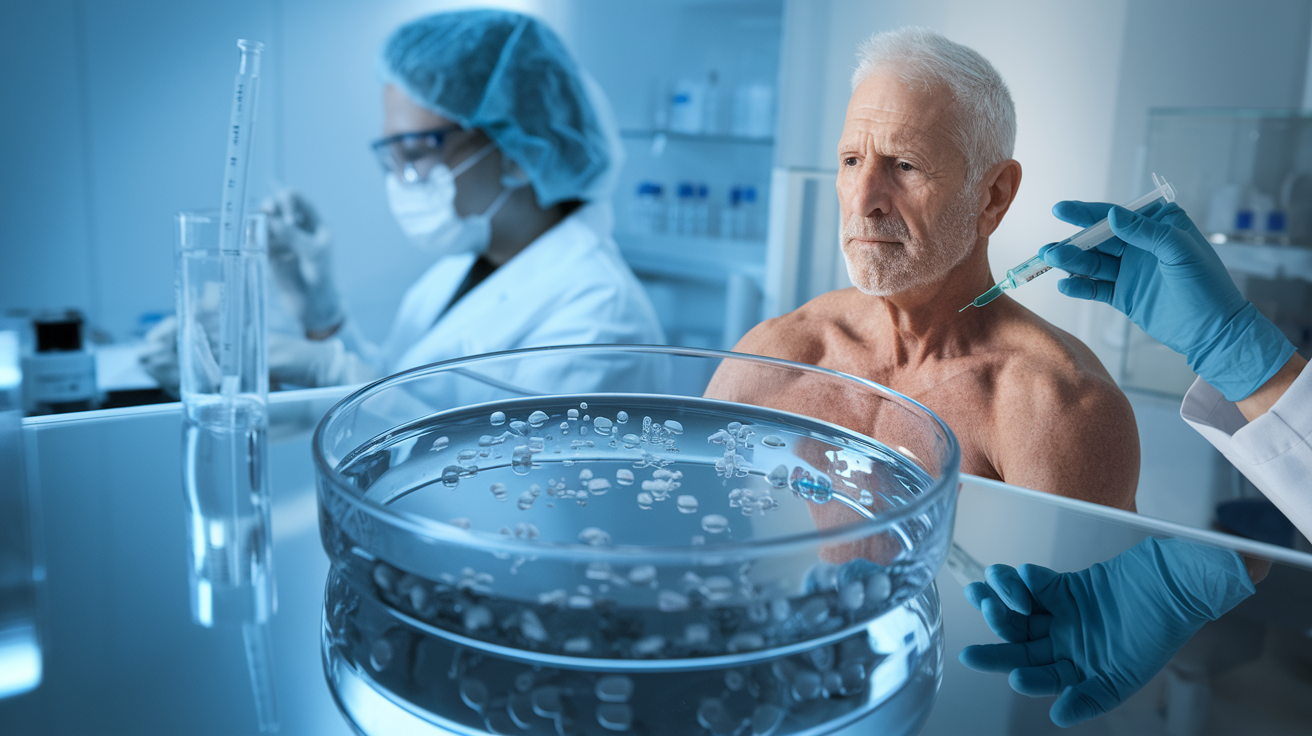
What MSC therapy is trying to do: give that repair system a boost from outside. Mesenchymal stem cells — from your own bone marrow or fat tissue, usually — get injected into the muscles that need help. Two things supposedly happen. The MSCs themselves can differentiate into muscle cells. And — probably more important — they secrete growth factors and anti-inflammatory signals that activate the native satellite cells that are already there but sluggish. You're not replacing the system. More like jump-starting it.
There's real data here. Mayo Clinic published a 39-person trial in 2021 specifically on sarcopenia — walking speed and grip strength improved significantly at six months. Small study but solid methodology. Research out of Madrid's Jiménez Díaz Foundation going back to 2019 tracks muscle fiber quality (not just mass) and finds improvements that hold past 18 months. Orthopedic injury applications — rotator cuff, hamstring tears — have even more established evidence, multiple trials, better powered.
General anti-aging muscle optimization is thinner. You're earlier in the evidence curve there.
Prices in 2026, and why you can't take any single number seriously
For one or two targeted muscle groups, US clinic pricing runs $3,500-$8,500 per session. That's roughly where it's settled. Multi-site comprehensive programs with IV infusion added: $15,000-$25,000+. The full cost comparison by procedure type is here if you want to get specific.
Here's the thing about why the range is so wide. Some of it is real cost difference — the cell processing infrastructure has a real floor, you can't legitimately do it for $500, the GMP-compliant labs and trained technicians and viability testing all cost money. But some of it is location premium (Beverly Hills tax is real), some of it is overhead markup, and some of it is that better clinics are doing more advanced stuff — ultrasound-guided injection targeting, exosome combination protocols — that actually is more expensive and probably more effective.
The Steadman Clinic in Vail charges a lot and it's worth more than a random Scottsdale wellness center charging similarly, because the Steadman has actual outcome data. That matters.
Mexico and across the border
A lot of people go. The math makes sense — Tijuana and Monterrey have clinics charging $2,000-$5,000 for procedures that cost $8,000-$15,000 in the US. Here's what to look for in Mexican clinics specifically. Some are genuinely excellent. Real physicians, real labs, real cell processing. The lower cost reflects lower overhead and labor costs, not necessarily worse medicine.
But the bad actors are also clustered here. 2023 FDA investigation found sixteen border-adjacent clinics selling either empty products (no viable cells), contaminated products, or just nothing. All were advertising aggressively and pricing between $800-$1,500. That price is not compatible with legitimate MSC processing. Walk away from anything in that range.
Exosomes — the newer option worth knowing about
I kept running into this while researching. Exosomes are tiny vesicles that MSCs naturally release — they carry the growth factors and signaling molecules that do the actual repair work. You can manufacture them without transplanting whole cells, which simplifies everything: manufacturing, immune compatibility, storage. Cleveland Clinic published data in 2025 comparing exosomes to standard MSC therapy for skeletal muscle — outcomes were comparable on primary measures. Cost is $2,000-$5,000 versus $4,000-$9,000 for cells. Several researchers I came across think this is where the field actually goes next. Worth asking about if you're talking to clinics.
Which condition are you treating
Really matters. Specific localized injury — partial hamstring tear, chronic rotator cuff issue, something orthopedic that hasn't healed properly — the evidence base is stronger and outcomes are more predictable. Generalized sarcopenia is more experimental territory, you're further out on the evidence curve. The condition-specific guides here break down what the actual data looks like for different diagnoses.
The honest take
My uncle is 30% better. He'll probably do another round. He thinks it was worth it. I can't argue with him too hard — I watched him carry the cooler back inside at the end of the night without asking for help, which he couldn't do when I arrived.
But if you're considering this: exhaust the basics first. Creatine monohydrate has more evidence behind it for muscle preservation in older adults than almost anything else. Protein at 1.6-2.0 grams per kilogram of bodyweight (most people are under). Progressive resistance training — actually progressive, not maintenance level. These aren't exciting answers but they're real.
Then if you've genuinely done all of that and you're still losing ground, and you've found a clinic with actual outcome data, not Instagram testimonials — stem cells or exosomes are a reasonable next conversation. The downside risk for autologous cell therapy from a credible clinic is low. The potential upside, based on what I've read and what I watched my uncle do with that cooler, is real.